Daily Duas Every Muslim Should Know for Peace, Protection, and Guidance
Every day brings new challenges, responsibilities, and moments when we need Allah’s help. One of the simplest ways to stay connected with Him is by reciting authentic daily duas taught in the Qur’an and Sunnah. These supplications remind us to place our trust in Allah, seek His protection, and remain grateful in every situation.
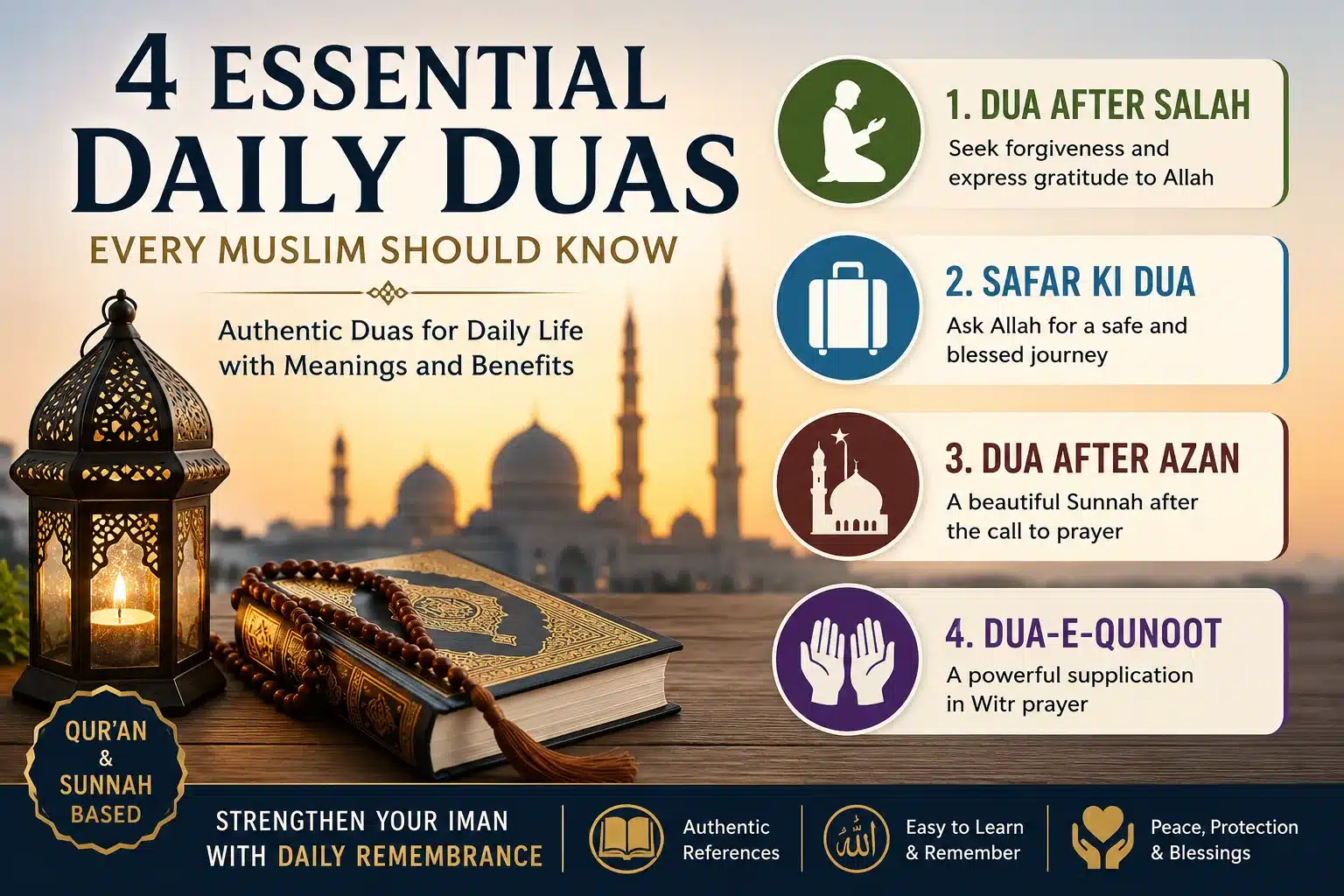
This guide explains four essential daily duas that every Muslim should know: the dua after Salah, Safar Ki Dua (travel supplication), the dua after Azan, and Dua-e-Qunoot. You’ll learn when to recite them, why they matter, and how they can become a meaningful part of your daily worship.

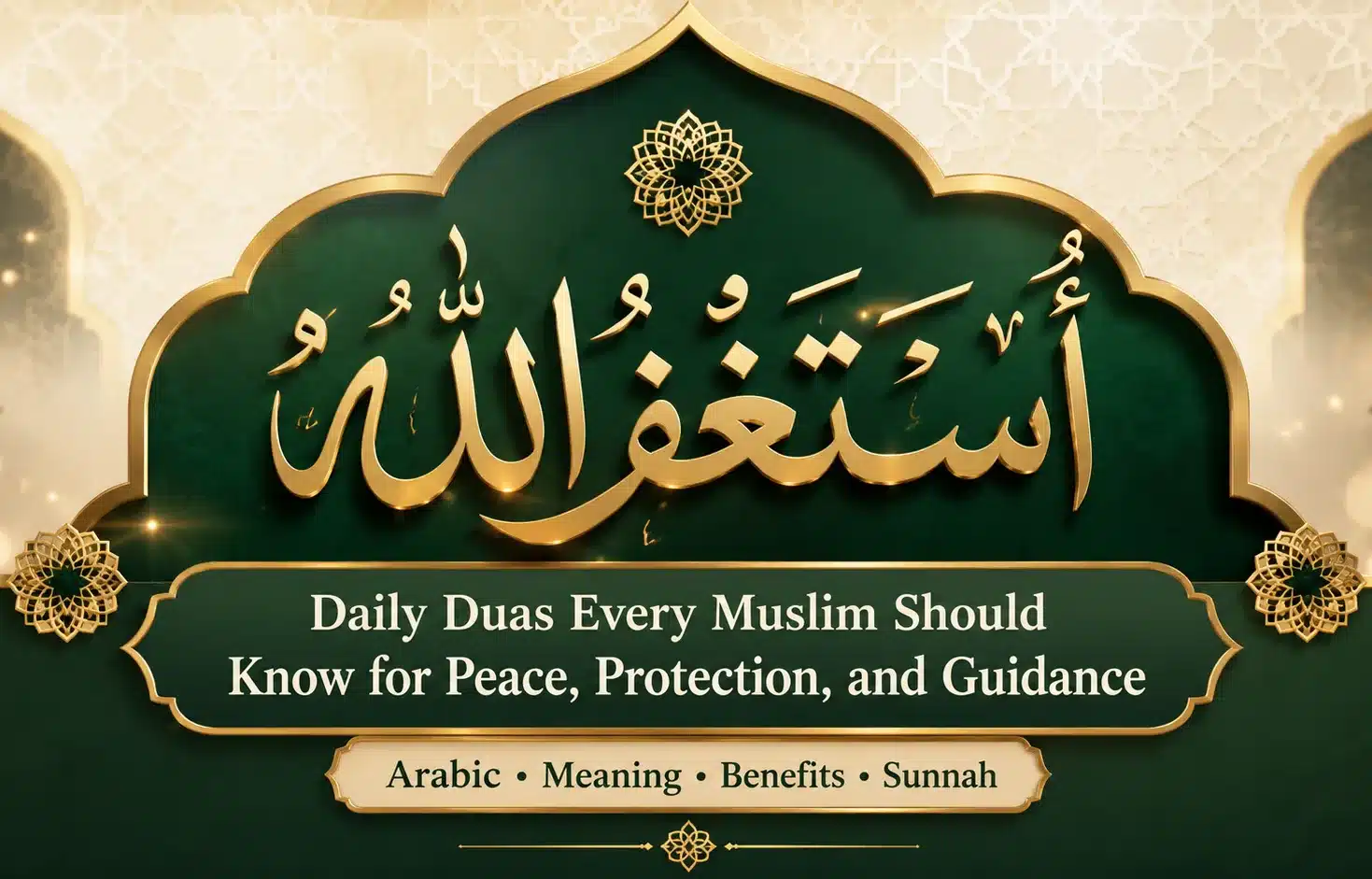
Astaghfirullah-arabic
Why Daily Duas Matter in a Muslim’s Life
A dua is a sincere supplication made to Allah. It is an act of worship that allows a believer to express gratitude, seek forgiveness, ask for guidance, and place complete trust in the Creator. Unlike formal Salah, duas can be made at many times throughout the day, making them an easy way to remember Allah wherever you are.
The Prophet Muhammad (peace and blessings be upon him) regularly recited different supplications during everyday activities. He taught his companions to remember Allah before travelling, after completing prayers, upon hearing the Adhan, before sleeping, after waking up, and in many other daily situations. Following these Sunnah practices helps Muslims strengthen their faith and keep their hearts connected to Allah throughout the day.
These supplications are not magical formulas or guarantees of worldly success. Instead, they are acts of worship that encourage sincerity, patience, gratitude, and reliance upon Allah. Muslims recite them with hope in Allah’s mercy while recognising that He alone knows what is best.
Daily duas are authentic Islamic supplications recited during everyday activities to seek Allah’s guidance, protection, forgiveness, and blessings. They help Muslims remember Allah throughout the day and strengthen their spiritual connection with Him.
Four Essential Daily Duas at a Glance
| Dua |
When to Recite |
Main Purpose |
| Dua After Salah |
After every obligatory prayer |
Remembering Allah and seeking forgiveness |
| Safar Ki Dua |
Before beginning a journey |
Seeking protection and ease during travel |
| Dua After Azan |
After hearing the Adhan |
Praying for the Prophet (peace be upon him) and responding to the call to prayer |
| Dua-e-Qunoot |
During Witr prayer |
Seeking guidance, protection, and Allah’s mercy |
Benefits of Learning Authentic Daily Duas
Learning authentic daily duas offers much more than memorising Arabic words. It helps build a consistent habit of remembering Allah during ordinary moments of life. Even a short supplication can bring comfort and remind a believer that Allah is always near.
- Strengthens your relationship with Allah through regular remembrance.
- Helps you follow the Sunnah of the Prophet Muhammad (peace and blessings be upon him).
- Brings peace and reassurance during times of difficulty.
- Encourages gratitude during everyday blessings.
- Makes ordinary activities opportunities for worship.
- Creates a strong spiritual routine for both adults and children.
As you continue reading, you’ll learn each dua individually, including its purpose, when it should be recited, and the authentic Islamic guidance behind it. Where appropriate, we’ve also linked to detailed guides for readers who want to explore each supplication in greater depth.
Dua After Salah (Prayer): Remember Allah After Every Prayer
Finishing Salah does not mean your worship has ended. The moments immediately after the obligatory prayer are among the best times to remember Allah, seek His forgiveness, and make personal supplications. The Prophet Muhammad (peace and blessings be upon him) regularly engaged in dhikr and authentic duas after Salah, teaching his companions to continue remembering Allah even after the prayer was complete.
Many Muslims refer to this as the “dua after Salah.” Rather than one fixed supplication, the Sunnah includes several authentic remembrances and prayers that may be recited after each obligatory prayer.
One Authentic Supplication After Salah
The Prophet (peace and blessings be upon him) would seek Allah’s forgiveness immediately after completing the prayer.

Arabic
أَسْتَغْفِرُ اللَّهَ
Transliteration
Astaghfirullah
English Meaning
I seek Allah’s forgiveness.
Another Authentic Supplication
Arabic
اللَّهُمَّ أَنْتَ السَّلَامُ وَمِنْكَ السَّلَامُ، تَبَارَكْتَ يَا ذَا الْجَلَالِ وَالْإِكْرَامِ
Transliteration
Allahumma Antas-Salaam wa minkas-Salaam tabarakta ya Dhal-Jalaali wal-Ikraam.
English Meaning
O Allah, You are Peace, and from You comes peace. Blessed are You, O Possessor of Majesty and Honour.
When Should You Recite This Dua?
- After every obligatory Salah.
- Before leaving your place of prayer.
- Before making your personal dua.
Why is This Sunnah Important?
Seeking forgiveness immediately after Salah reminds us that no act of worship is perfect. Even after completing prayer, Muslims ask Allah to accept their worship and overlook any shortcomings. This teaches humility and strengthens sincerity.
Benefits of Remembering Allah After Salah
- Follows the Sunnah of the Prophet (peace and blessings be upon him).
- Strengthens daily remembrance of Allah.
- Encourages gratitude after worship.
- Creates a peaceful transition from prayer into daily life.
- Builds consistency in worship.
Related Article: Learn more authentic supplications after prayer, including Arabic text, transliteration, and detailed explanations in our complete guide to Dua After Salah.
Authenticity Note
These supplications are established through authentic narrations. Muslims should avoid sharing unauthenticated duas or claiming that a specific supplication guarantees particular worldly outcomes without reliable Islamic evidence. Allah knows best.
Safar Ki Dua: The Sunnah Prayer Before Travelling
Whether you are travelling by car, bus, train, airplane, or another means of transport, Islam encourages beginning every journey by remembering Allah. The well-known Safar Ki Dua is one of the beautiful Sunnah supplications taught by Prophet Muhammad (peace and blessings be upon him).
Reciting this dua reminds believers that every journey is under Allah’s control and that true safety comes only through His protection.
safar ki dua in english
Qur’anic Foundation
The wording of this supplication reflects the Qur’anic reminder:
“Glory be to Him Who has subjected this for us, though we could never have accomplished it on our own. And surely to our Lord we will return.” — Qur’an 43:13–14
Safar Ki Dua (Arabic)
سُبْحَانَ الَّذِي سَخَّرَ لَنَا هَذَا وَمَا كُنَّا لَهُ مُقْرِنِينَ وَإِنَّا إِلَى رَبِّنَا لَمُنْقَلِبُونَ
Transliteration
Subhanalladhi sakhkhara lana hadha wa ma kunna lahu muqrineen wa inna ila Rabbina lamunqaliboon.
Simple English Meaning
Glory be to Allah, Who has made this means of transport available to us, although we could never have controlled it by ourselves. Surely we will all return to our Lord.
When Should You Read Safar Ki Dua?
- Before leaving home for any journey.
- Before driving a vehicle.
- Before boarding a plane.
- Before travelling by train or bus.
- Before beginning a long-distance journey.
Lessons We Learn from This Dua
- Recognise that every journey depends on Allah’s permission.
- Remain grateful for the blessing of transportation.
- Remember that life itself is a journey towards Allah.
- Place trust in Allah while also taking practical safety measures.
Common Mistakes
- Waiting until after the journey has started to remember Allah.
- Reciting the dua quickly without understanding its meaning.
- Thinking that the dua replaces practical safety precautions such as wearing a seatbelt or following travel rules.
Islam teaches believers to combine trust in Allah (tawakkul) with responsible action.
Authenticity Note
This travel supplication is rooted in the Qur’an Sharif and authentic Sunnah. Muslims should recite it with sincerity while taking sensible precautions during travel. The dua is an act of worship and reliance upon Allah, not a guarantee that difficulties will never occur. Allah knows best.
Dua After Azan: A Beautiful Sunnah Supplication
When you hear the Adhan (call to prayer), Islam encourages you to stop for a moment, listen carefully, and repeat the words of the Mu’adhdhin where appropriate. After the Adhan ends, the Prophet Muhammad (peace and blessings be upon him) taught a special supplication known as the Dua After Azan.
Dua After Azan
This short but meaningful dua asks Allah to grant the Prophet Muhammad (peace and blessings be upon him) the honoured station known as Al-Wasilah. Reciting it is a simple Sunnah that brings great spiritual reward.
Arabic
اللَّهُمَّ رَبَّ هَذِهِ الدَّعْوَةِ التَّامَّةِ وَالصَّلَاةِ الْقَائِمَةِ، آتِ مُحَمَّدًا الْوَسِيلَةَ وَالْفَضِيلَةَ، وَابْعَثْهُ مَقَامًا مَحْمُودًا الَّذِي وَعَدْتَهُ
Transliteration
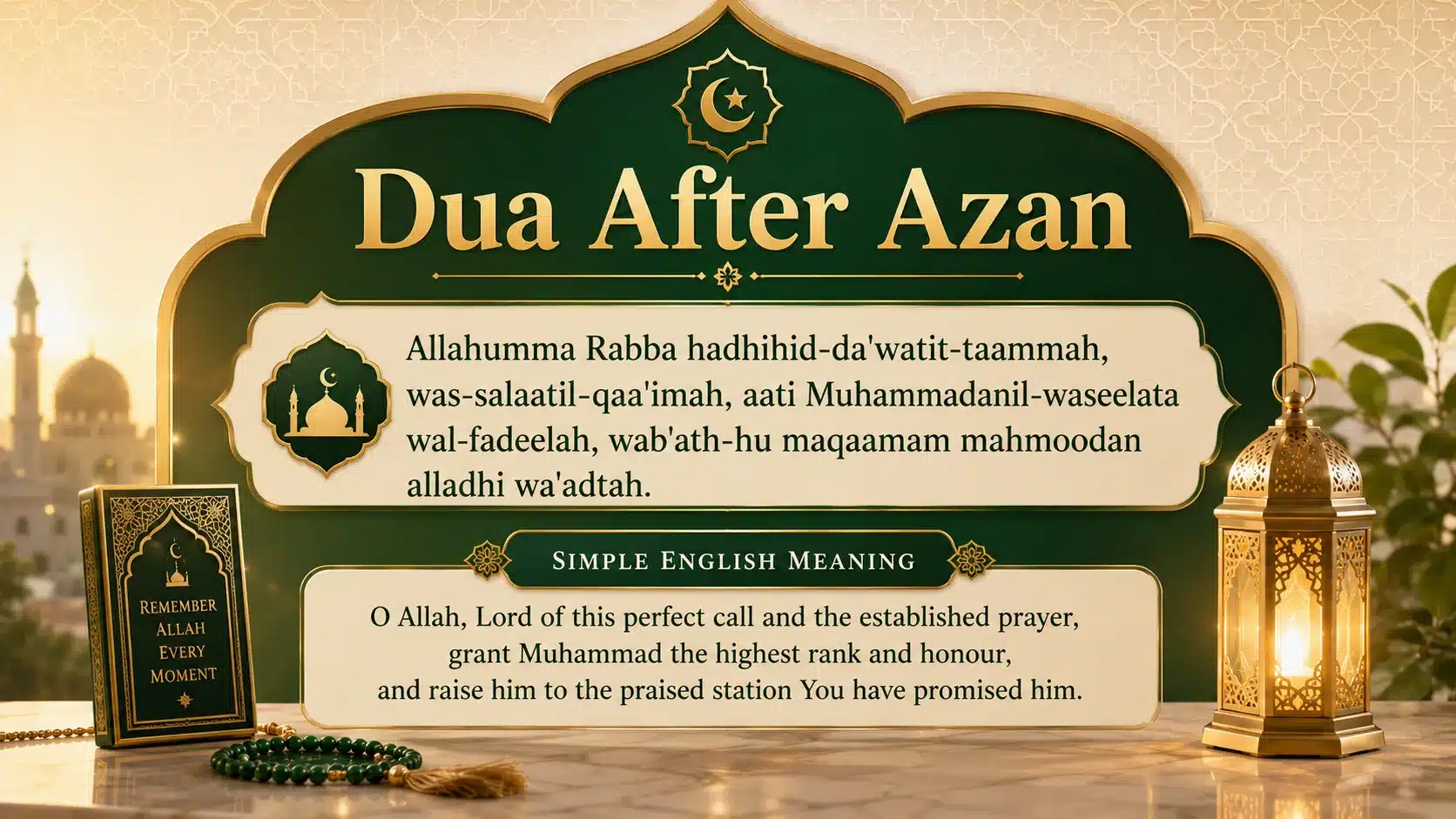
Allahumma Rabba hadhihid-da’watit-taammah, was-salaatil-qaa’imah, aati Muhammadanil-waseelata wal-fadeelah, wab’ath-hu maqaamam mahmoodan alladhi wa’adtah.
Simple English Meaning
O Allah, Lord of this perfect call and the established prayer, grant Muhammad the highest rank and honour, and raise him to the praised station You have promised him.
Authentic Hadith
The Prophet Muhammad (peace and blessings be upon him) said:
“Whoever says this supplication after hearing the Adhan will receive my intercession on the Day of Resurrection, by Allah’s permission.” — Sahih al-Bukhari
When Should You Recite This Dua?
- Immediately after the Adhan finishes.
- Before the Iqamah begins.
- After repeating the words of the Mu’adhdhin according to the Sunnah.
Lessons We Learn
- Respond positively to Allah’s call to prayer.
- Increase love for Prophet Muhammad (peace and blessings be upon him).
- Remember that every Salah begins with the remembrance of Allah.
- Strengthen your daily connection with Islamic worship.
Common Mistakes
- Talking throughout the Adhan without listening.
- Leaving immediately without making the Sunnah supplication.
- Reciting the dua mechanically without understanding its meaning.
- Assuming it is optional because it is short.
Although this dua is brief, making it a regular habit helps revive an authentic Sunnah in daily life.
Authenticity Note
This supplication is authentically reported in Sahih al-Bukhari. Muslims should preserve its wording as taught by the Prophet (peace and blessings be upon him) and avoid adding unsupported phrases or promises regarding its benefits. Allah knows best.
Dua-e-Qunoot: Asking Allah for Guidance and Protection
Dua-e-Qunoot is one of the best-known supplications recited during the Witr prayer. It is a sincere request for Allah’s guidance, forgiveness, protection, and blessings. Many Muslims learn this dua during childhood because it forms part of their regular night prayer.
Although scholars have discussed different authentic wordings and practices regarding Qunoot, the well-known version taught in many Sunni communities is based on authentic narrations. Where scholarly differences exist, they should be respected without turning them into disputes. Allah knows best.
Opening Words (Arabic)
اللَّهُمَّ اهْدِنِي فِيمَنْ هَدَيْتَ
Transliteration
Allahumma ihdini feeman hadayt.
Simple English Meaning
O Allah, guide me among those whom You have guided.
The complete Dua-e-Qunoot continues by asking Allah for protection, blessings, forgiveness, and help while acknowledging that all good comes from Him alone.
When Is Dua-e-Qunoot Recited?
- During the Witr prayer.
- Usually in the final rak’ah of Witr according to many Sunni scholars.
- During special circumstances when Qunoot An-Nazilah is performed, according to authentic Sunnah and scholarly guidance.
Why Is Dua-e-Qunoot Important?
This beautiful supplication teaches complete dependence upon Allah. Instead of relying only on personal ability, Muslims ask Allah for guidance, protection, blessings, and forgiveness in every aspect of life.
Spiritual Lessons
- True guidance comes only from Allah.
- Every blessing belongs to Allah.
- Protection from hardship should be sought through sincere worship.
- Humility is an essential part of every believer’s relationship with Allah.
Common Questions
Do all Muslims recite Dua-e-Qunoot in the same way?
There are recognised scholarly differences regarding certain details of Qunoot. These differences are well known among Sunni scholars and should be respected. Muslims should follow authentic guidance as taught by knowledgeable scholars within their tradition.
Can children learn Dua-e-Qunoot gradually?
Yes. Many families teach one sentence at a time while explaining the meaning in simple language. Understanding the words often makes memorisation easier.
Common Mistakes
- Trying to memorise the entire dua in one day.
- Reciting it without understanding its meaning.
- Arguing over accepted scholarly differences.
- Depending on unreliable versions shared online without verification.
Authenticity Note
Dua-e-Qunoot is established through authentic Islamic sources, while some details of its wording and practice involve recognised scholarly differences. Muslims should rely on authentic evidence and qualified scholarship rather than unverified social media posts. Allah knows best.
How to Make Daily Duas a Natural Part of Your Routine
Many Muslims want to recite more duas but struggle to remember them consistently. The best approach is to start with one authentic supplication, understand its meaning, and practise it every day. Small, consistent acts of worship are beloved to Allah.
Prophetic Guidance: The Prophet Muhammad (peace and blessings be upon him) taught that the most beloved deeds to Allah are those that are consistent, even if they are small.
A Simple 7-Step Plan
- Learn one authentic dua at a time.
- Read the Arabic along with the transliteration.
- Understand the English meaning before memorising it.
- Recite it daily until it becomes a habit.
- Teach it to your children or family members.
- Use trusted Islamic resources to verify every supplication.
- Continue learning a new Sunnah dua every few weeks.
By following this simple routine, daily remembrance of Allah becomes easier and more meaningful.
Your Daily Dua Checklist
| Daily Situation |
Recommended Dua |
Status |
| After every Salah |
Dua After Salah |
✓ Daily |
| Before travelling |
Safar Ki Dua |
✓ As Needed |
| After hearing the Adhan |
Dua After Azan |
✓ Five Times Daily |
| During Witr Prayer |
Dua-e-Qunoot |
✓ Night Prayer |
Keeping a simple checklist like this helps turn occasional remembrance into a regular habit.
Common Mistakes Muslims Should Avoid
Learning authentic duas is not only about memorising Arabic words. It is equally important to understand their meaning and follow authentic Islamic guidance.
1. Reading Without Understanding
Even if you cannot understand every Arabic word immediately, learning the meaning helps increase sincerity and concentration.
2. Using Unverified Duas
Many supplications shared online have no authentic source. Whenever possible, verify that a dua comes from the Qur’an or authentic Hadith.
3. Expecting Guaranteed Worldly Results
Duas are acts of worship. Allah answers every sincere supplication according to His perfect wisdom. Muslims should avoid claims that any dua guarantees wealth, marriage, success, or protection unless authentic Islamic evidence clearly supports those claims.
4. Inconsistency
Reading one authentic dua every day is often more beneficial than reading many supplications only occasionally.
5. Forgetting the Sunnah
The Prophet Muhammad (peace and blessings be upon him) remembered Allah throughout the day. Following his example brings barakah into everyday life.
Benefits of Reciting Authentic Daily Duas
Daily duas do not remove every difficulty from life, but they strengthen a believer’s relationship with Allah and increase remembrance throughout the day.
- They encourage trust in Allah during both ease and hardship.
- They help Muslims remember Allah regularly.
- They revive authentic Sunnah practices.
- They increase gratitude for everyday blessings.
- They help families teach Islamic values to children.
- They make ordinary activities acts of worship.
- They strengthen hope, patience, and sincerity.
The greatest benefit of every authentic dua is closeness to Allah through sincere worship.
Continue Learning More Authentic Daily Duas
These four supplications are an excellent starting point, but Islam teaches many beautiful duas for different situations throughout the day.
Related Articles You May Find Helpful
Together, these articles form a complete collection of authentic Sunnah supplications that can help you remember Allah from morning until night.
Frequently Asked Questions (FAQs)
1. What are daily duas in Islam?
Daily duas are authentic Islamic supplications recited during different parts of the day. They help Muslims remember Allah, seek His guidance, ask for forgiveness, and express gratitude. Many of these duas come directly from the Qur’an and the authentic Sunnah.
2. Which dua should I read after every Salah?
One of the authentic supplications after Salah begins with Astaghfirullah, followed by other remembrances taught by the Prophet Muhammad (peace and blessings be upon him). Muslims are encouraged to remember Allah and make personal supplications after completing the obligatory prayers.
3. When should I recite Safar Ki Dua?
Safar Ki Dua should be recited before beginning a journey, whether travelling by car, bus, train, aeroplane, or another means of transport. It is a Sunnah supplication asking Allah for protection, ease, and a safe journey.
4. Why is the Dua After Azan important?
The Prophet Muhammad (peace and blessings be upon him) taught Muslims to recite this supplication after hearing the Adhan. According to authentic Hadith, it is a means of seeking Allah’s mercy and the Prophet’s intercession by Allah’s permission.
5. What is Dua-e-Qunoot?
Dua-e-Qunoot is a supplication commonly recited during the Witr prayer. It asks Allah for guidance, forgiveness, protection, and blessings. There are recognised scholarly discussions regarding some details of its wording and practice.
6. Can I read duas in English?
Yes. While the Arabic wording of authentic Sunnah duas is preferred, understanding the meaning is highly beneficial. Personal supplications may also be made in your own language.
7. Do duas guarantee that my problems will disappear?
No. Islam teaches that Allah answers every sincere supplication according to His perfect wisdom. Sometimes the answer comes immediately, sometimes later, and sometimes Allah replaces it with something better. Muslims continue making dua with patience, trust, and hope.
8. How can beginners memorise daily duas?
Begin with one short authentic dua, learn its meaning, recite it consistently every day, and gradually add more supplications. Teaching family members together can also make memorisation easier.
9. Where can I find authentic daily duas?
Always use reliable Islamic sources based on the Qur’an and authentic Hadith. Verify any supplication before sharing it, especially if it comes from social media or unofficial websites.
10. Which daily duas should every Muslim know?
Every Muslim should try to learn essential Sunnah supplications, including the Dua After Salah, Safar Ki Dua, Dua After Azan, Dua-e-Qunoot, morning and evening adhkar, and other authentic daily duas taught by the Prophet Muhammad (peace and blessings be upon him).
Final Reflection
Life is filled with moments of joy, uncertainty, travel, worship, and personal challenges. Islam teaches that every one of these moments is an opportunity to remember Allah through sincere supplication.
Whether you are completing your Salah, beginning a journey, responding to the Adhan, or standing in Witr prayer, these authentic duas remind you that Allah is always near and always hears the sincere prayers of His servants.
You do not need to memorise every dua immediately. Begin with one authentic supplication, understand its meaning, practise it daily, and gradually build your knowledge over time. Small, consistent acts of remembrance can become lifelong habits that strengthen your faith and bring peace to your heart.
Authenticity Reminder: This guide presents authentic Islamic supplications based on the Qur’an and Sunnah wherever applicable. For detailed questions of Fiqh or scholarly differences, consult a qualified Islamic scholar. Allah knows best.