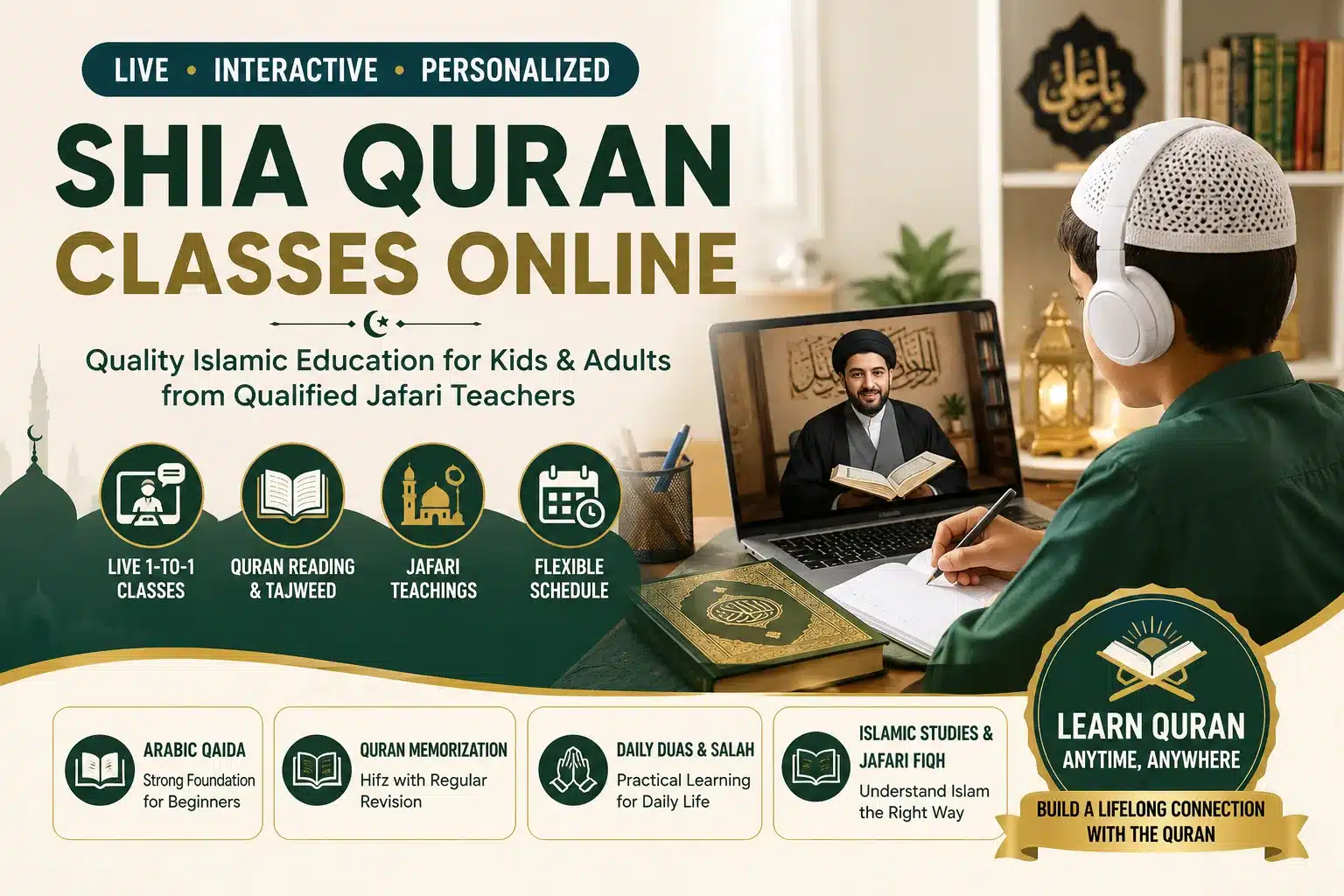
Learn Shia Quran Teaching Online – The Best Guide for Kids and Adults
Finding a qualified Quran teacher from the Shia school of thought is not easy especially for many Muslim families living in countries where Shia Islamic education is not easily available. Many muslim parents want their kids to learn Holy Quran Majeed with correct pronunciation, Tajweed, and true Islamic values but local options are sometimes limited or difficult to reach.
Shia Quran Teaching Online have made Quality Islamic education available to everyone at your finger tips. Live one to one lessons are offered so that students of all ages can learn from experienced teachers without leaving their homes. If you wish to assist your child in reading the Quran fluently, enhance your own recitation, memorize specific Surahs or grasp the basic concepts of the Jafari teachings, online learning offers a flexible and personalized approach that corresponds to the demands of contemporary family life.
Why Muslim Families are increasingly turning to Online Shia Quran Classes
Over the past several years, thousands of Muslim families from the United States, Canada, United Kingdom, Australia, New Zealand, Europe and many other parts of the world have chosen online Islamic education as their favorite.
The reason is simple. Quality Quran education is no longer confined to local mosques or Islamic centres for families. As long as they have a stable internet connection and a computer, tablet or smartphone, students can learn from qualified teachers, no matter where they live.
This convenience has opened up new possibilities for families who live in areas where experienced Shia Quran teachers are hard to come by. Rather than making the long journey several times a week, students can attend live classes from the comfort of their own homes and still keep up with their school, work and family routines.
Parents also welcome a higher level of involvement in their children’s education. Lessons are held at home so they can watch lessons, track progress, contact teachers and motivate to revise between lessons regularly.
What are online Shia Quran classes?
Online Shia Quran classes are live, interactive sessions happening via secure video conferencing platforms. Unlike pre-recorded videos, where students only learn in a one-way manner, live sessions allow students to communicate directly with their teacher in every lesson.
Students can ask questions when they have confusion, practice Quran recitation, get instant correction in pronunciation and learn at their own pace. This interactive approach closely mirrors the experience of face-to-face teaching but with far greater flexibility.
Most professional academies adapt their lessons to the age, previous experience and individual learning objectives of the student. If you are a total beginner then your study plan is different than someone who already knows basic Quran reading or wants to improve Tajweed.
What students typically learn: Subject Learning Outcomes
- Arabic Qaida Arabic alphabet, pronunciation, rules of joining, reading basics.
- Quran Reading Learn to read the Quran fluently and accurately in a step-by-step process.
- Tajweed Learn and apply the rules of correct pronunciation of the Qur’an.
- Quran Memorisation (Hifz) Memorise Surahs with systematic revision and regular practice.
- Daily Duas Get real duas for your daily situations.
- Salah (Namaz) Know the practical way of prayer and its importance.
- Islamic Studies Develop knowledge of Islamic beliefs, ethics and history and Islamic manners.
- Jafari Fiqh Study the basic religious rulings according to the Shia school.
Every lesson builds on the previous one so students gain confidence without being overwhelmed. Teachers regularly assess progress and adjust the learning plan to offer additional support as needed.
Why Personalised One-to-One Learning is a Game Changer
No two students learn exactly the same way. Some children are quick to identify the Arabic letters while others need a bit more time to gain confidence before reading complete words and verses. Adults returning to Quran study after many years may also have different learning needs from those of younger students.
In the traditional classroom, one teacher can only spread his or her attention among many students. This causes some students to be reluctant to ask questions and some students to move too quickly for the class to keep up.
Online individual lessons resolve these problems by providing each student with the full attention of the teacher during the lesson.
Traditional Group Classes 1-on-1 Online Learning
- Teacher spreads attention among many students.The entire lesson centers on one learner.
- The classroom is the same speed for all.Lessons are paced to the student’s ability.
- Little chance for individual correctionImmediately corrected pronunciation errors.
- Students may be reluctant to ask questions.Private lessons stimulate communication.
- Establish schedules with travel requirements.Flexible hours from the comfort of your own home.
Such a tailored approach often means that students can become more confident quicker as each lesson is tailored to the student’s own strengths, weaknesses and learning goals.
Learning in Jafari School of Thought
For many Shia Muslim families, picking a Quran academy means finding teachers who know the beliefs and practices of the Jafari school.
“Learning from those who know Shia teachings helps children understand what they are being taught during their Quran lessons and to practice at home with their families”
Daily duas, Islamic Manners, Salah, basic Aqeedah and practical religious guidance according to their age and level of understanding along with Quran recitation are taught to the students.
The aim is more than just teaching children to read Arabic words. It also aims to help them establish a meaningful relationship with the Quran, and to strengthen their Islamic character through regular practice, sincerity, respect, honesty, patience and gratitude.
Who can avail of Online Shia Quran Classes?
Online Quran education is for learners of every age group. Each lesson is personalised, so students are placed according to what they know, not how old they are.
- Young children learning Arabic letters for the first time.
- School Students Learning Quran Reading with Tajweed .
- Teenagers preparing for organized Hifz programmes.
- University students balancing education and Quran studies.
- Busy professionals who don’t have much free time.
- Parents who want to improve their reciting.
- New Muslims beginning their journey of learning the Quran.
- Entire families who want to learn together.
Many academies also provide flexible scheduling, which allows different family members to take lessons at a time that suits their daily routines.
Building strong Quran reading skills from the start
To learn the Quran in the long run, a good foundation is needed. The experienced teachers do not rush the students to read full verses but make sure they learn the Arabic letters, the pronunciation and the correct sounds of each letter first.
This systematic process helps to avoid confusion later on and allows students to gain confidence and tackle longer passages from the Holy Quran.
Teachers continuously review previous lessons so that students can build their reading fluency and fix little mistakes before they become entrenched habits.
Frequent review and reinforcement often leads to better results than trying to race through the course, and steady progress is the best way to get there.
A well-structured curriculum for each learning stage
A good online Shia Quran programme is supposed to help students move slowly and not bombard them with too much information at a go. Each lesson builds on what the learner has already learned, allowing them to become proficient in reading the Quran while also learning more about Islam.
Good teachers do not only teach recitation but also combine Quran education with practical Islamic learning. This balanced approach allows students to relate what they learn in the classroom to their daily lives.
Most structured programs, although varying in syllabus from academy to academy, contain some essential subjects that help in the long-term education in the Quran.
Arabic Qaida: The Confident First Step to Quran Reading
All successful Quran learners begin with a solid foundation. Arabic Qaida introduces the Arabic alphabet, correct pronunciation, joining of letters and basic reading patterns to students before they start reading verses from the Holy Quran.
Teachers help students distinguish between similar pronunciations by carefully explaining the sound each letter makes. This stage requires patience but prepares the learners for accurate recitation of the Qur’an in the future.
Instead of rushing through lessons, qualified instructors promote frequent practice so that students become comfortable recognising letters without hesitation.
A good understanding of Qaida minimizes future reading errors and makes the transition to Quran recitation much easier.
Quran Reading with Confidence and Accuracy
Once students learn the basics of reading Arabic, they begin reciting Holy Quran in front of their teacher.
Lessons focus on building fluency, one verse at a time. teachers listen closely, spot mispronunciations, give immediate feedback before the errors become permanent.
Regular revision also plays an important part. Often students find themselves going over Surahs and verses they already know to increase confidence and reading accuracy.
As learners become more fluent they start to feel more comfortable reading on their own and pronouncing correctly.
How to Learn Tajweed Practically
Tajweed is the set of rules for the correct pronunciation of the Holy Quran. These rules help to preserve the accurate articulation of each and every Arabic letter and help the reader to recite the Quran as accurately as possible.
Experienced teachers will often introduce Tajweed naturally during recitation practice instead of requiring students to memorise technical terminology from the beginning.
This practical way of teaching enables students to grasp the meaning of each rule in real Qur’anic verses and not abstract definitions.
Tajweed classes usually cover the following topics:
- Proper enunciation of Arabic letters (Makharij).
- Sifaat of letter qualities.
- The Rules of Noon Sakinah and Tanween.
- Meem Sakinah is the Rule.
- Correct stopping and starting of recitation.
- The rhythm of recitation is smooth and balanced.
In each lesson students slowly apply these rules until the correct pronunciation becomes a natural habit
Quran Memorization (Hifz) with Regular Revisions
Many students want to memorise parts of Holy Quran and others want to complete full Hifz. Consistently is the key to memorisation success, not speed, no matter what the goal is.
Experienced teachers develop structured memorisation plans that are appropriate for the age, ability and time available for study for each student.
New verses are slowly introduced and previously memorized portions are periodically reviewed to enhance long-term retention.
Learn Daily Duas for Everyday Life
Islam encourages its followers to remember Allah in their daily activities. So, a lot of online Shia Quran classes have authentic daily duas included in their curriculum.
Children and adults learn in time the prayers that they can say in the situations that they meet every day.
- Before you eat.
- Having eaten.
- Before you sleep.
- When I woke up.
- Before you travel
- Home entry and departure.
- Going in and out of mosque.
- A seeking of refuge and forgiveness from Allah.
Teachers also explain the meaning of these duas in an easy language so that students understand what they are reciting and not just memorise words without understanding.
Teaching Salah with Comprehension
Learning how to do Salah properly is one of the important parts of Islamic education. Online Quran teachers teach students each step of prayer and interpret its importance according to their level of understanding.
Lessons include the order of prayer, the proper recitation, bodily movements and the importance of sincerity in worship.
Children are also encouraged to develop regular prayer routines as they learn the Qur’an.
As Quran education and Salah develop hand-in-hand, students often find a deeper connection to their faith and become more confident in practicing Islam in their everyday lives.
Quran Learning with Developing Good Islamic Character
Islamic education is more than simply reading the Quran. Equally important is the application of its teachings through good character.
Most experienced teachers include brief discussions on Islamic manners within their lessons so students can understand how the teachings of the Quran can be applied to daily life.
Why parents love online Quran learning?
Parents find online Quran classes more convenient than the traditional classroom programmes as they can stay actively involved throughout their child’s educational journey.
Lessons are taught at home, giving parents the opportunity to see how their children are being taught, track attendance and speak to instructors directly, whenever they need to.
Many academies also give regular feedback on how the student is doing, so parents can see which areas need a little extra work between lessons.
This powerful partnership between teachers and families creates a supportive learning environment that encourages children to stay on track.
Choosing the Best Online Shia Quran Academy
Beyond comparing class fees, there’s more to choosing the right academy Parents should consider the standard of teaching, learning environment, curriculum and teacher qualifications before enrolling their children.
A good academy must have structure to the learning, but also patience, kindness and individual attention for the students.
Qualified Teachers to select, teachers need to be well-versed in holy Quran, knowledgeable about Tajweed and experienced in teaching students of various ages and learning capabilities.
A well-organized curriculum can help parents understand the journey from beginner lessons to more advanced studies of holy Quran for their children.
Detect Flexibility in Schedule
Families are balancing school, work and extra-curricular activities. Flexible class times make it easier to maintain regular attendance throughout the year.
In many academies, you can try a lesson without registering. This way parents can have a look at the quality of teaching and teachers can also have a look at the current level of the student.
Trial classes also help students adjust to the online learning environment before regular lessons begin.
Common Problems Faced by Students While Learning Quran Online
Every student learns differently and its OK to have some difficulties in the process. Some children become confident readers in a few months, others need extra practice and encouragement before they can read independently with ease.
Understanding these common challenges allows parents and teachers to work together and promote consistent progress, rather than immediate perfection.
Common Challenge How It Can Be Addressed
- Difficulty recognizing Arabic letters Practice for brief periods each day, not for long periods.
- Pronunciation errors You will be corrected regularly by a qualified Tajweed teacher.
- Lack of concentration Provide a quiet place to learn with few distractions.
- Busy school schedule Choose classes with flexible timings to fit in with the child’s schedule.
- Fear of screwing up. Ask questions. Celebrate small wins.
- Irregular home practice Establish a daily revision habit.
The process of learning these challenges. With patience, consistency and positive encouragement most students eventually get past them and continue to make meaningful progress.
Ways Parents Can Help Their Children Learn the Quran at Home
Holy Quran can be a lifelong friend to children if parents play an essential part in developing this relationship. You don’t need to be an Islamic scholar or an Arabic teacher to make a positive difference. The smallest habits each day often make the biggest difference.
When kids see that learning Holy Quran is a priority at home, they are more likely to stay motivated and build confidence in their studies.
1.Build A Learning Space
Find a quiet, comfortable place where your child can take lessons without many interruptions. A quiet environment will help students concentrate and stay on task during each session.
2. Follow a regular routine
Regular attendance teaches children discipline and prevents gaps in learning. Try to schedule classes at the same time each week, whenever possible.
3. Encourage daily short revision
Reviewing a little bit every day—just 10 or 15 minutes—can improve memory and fluency. Regular practice is more effective than the occasional long study periods.
4. Celebrate the Progress, Not the Perfection
Students learn at their own rate. Rather than comparing your child to others, focus on celebrating improvements in pronunciation, confidence and consistency.
5. Stay in Touch with the Teacher
Parents can have an open discussion to learn what the strengths are for their child, where additional practice is needed, and how to support learning goals outside of the classroom.
Signs That Your Child Is Doing Well
The success of learning holy Quran is not measured by the number of surahs that are memorized. There are many ways to look at steady improvement.
Parents should remember that making steady progress over time is much more important than rushing through lessons without creating a good base.
Typical Parent Mistakes To Avoid
Parents want their children to be successful, but sometimes unrealistic expectations can kill confidence instead of building it.
Being aware of these common mistakes leads to a more positive learning experience.
- Expecting to learn quickly without revision.
- One child versus another child.
- Changing teachers too often without allowing the student to adjust.
- Schedule conflicts that prevent attendance at lessons.
- Missing homework and revision time between lessons.
- Just memorizing without listening to the right pronunciation.
- Pushing the children too hard, rather than motivating them to improve gradually.
Learning the Quran is a life-long journey. Rarely will you get lasting results from moving too quickly. Consistent, patient, and sincere effort usually brings stronger, longer-lasting results.
FAQ’s
Are online Shia Quran classes good for complete beginners?
Yes. Most academies are open to beginners of all ages. Usually students start with learning the Arabic alphabet, correct pronunciation and basic reading, then move to reciting the Quran and learning Tajweed.
How many classes should a child have per week?
Many families have two to four lessons each week. The ideal timetable will vary according to the student’s age, school commitments, learning goals and the amount of revision he/she has done at home.
Are online Quran classes available for adults?
Of course. Online Quran learning is beneficial for children, teenagers, adults and senior learners. There are many adults who join to improve their recitation, to learn Tajweed or to start reading the Quran for the first time.
Is prior knowledge of Arabic required of students?
Nope. Beginners are taught step by step, starting with Arabic letters and pronunciation and then move to Quran reading.
What equipment do I need for online classes?
Generally, you need a stable internet connection, a computer, tablet or smartphone with a microphone and camera, headphones, and a quiet study area.
How long does it take to learn to read Qur’an?
There is no set time frame. Progress depends on regular attendance, consistent revision, individual learning ability and the guidance of a qualified teacher. Those who practice regularly generally improve gradually over time.
Can brothers and sisters learn together?
Some academies offer family learning choices, while others suggest separate one-to-one lessons so that every child can receive tailored tuition to suit their own learning pace.
Why is the revision important?
Repetition helps students to remember, to speak more freely and to retain what they have learned. Without regular review it is easier to forget material learned in the past.
Disclaimer of Authenticity
The article is for general educational use and provides a brief overview of online Shia Quran learning. The academies and the scholars may have different teaching methods, course structures and religious practices. Families looking for specific religious advice should consult qualified scholars or recognised religious authorities from their own tradition. And Allah knows best.
Start Your Quran Study With Confidence
Choosing the right Quran teacher is one of the best investments you can make in your family’s Islamic education. Take your time to explore the curriculum, meet the instructors and attend a trial lesson, before you make up your mind.
Students of all ages can gain confidence in Quran recitation and deepen their understanding of Islam for years to come through a supportive learning environment, qualified teachers, and consistent practice.
Author Profile

- Connect Via WhatsApp: +1 (786) 600-4511
-
Nadiya Khan is a devoted scholar of Islamic Studies and a seasoned writer with over 12 years of experience in crafting spiritually enriching Islamic content. Her expertise lies in presenting authentic duas and teachings from the Qur’an and Sunnah, rooted in the scholarly traditions of all four Sunni madhhabs - Hanafi, Shafi’i, Maliki, and Hanbali.
Through her work at the Islamic Dua Knowledge Hub, Nadiya brings timeless wisdom to life, offering Muslims practical, heartfelt guidance for navigating daily challenges with faith, clarity, and peace. Her writing is known for its precision, emotional depth, and unwavering commitment to authenticity, helping readers connect more deeply with Allah ﷻ through the power of sincere supplication.
Driven by a clear mission, Nadiya seeks to revive the practice of dua as a daily source of comfort, gratitude, and spiritual intimacy with the Creator. Her words are not just informative, they are a gentle invitation to reflect, reconnect, and rise.
🤝 Editorial Collaboration Opportunities
We welcome guest contributions from professionals, organizations, and service providers aligned with our values. For a nominal fee, our Islamic Guest Post service ensures your message reaches a dedicated audience while supporting the continued growth of this meaningful platform.
Latest entries
 Quran Majeed classesJuly 18, 2026Learn Shia Quran Teaching Online: The Best Guide for Kids and Families
- Islamic DuaJuly 18, 2026Dua After Eating: Complete Islamic Guide with Arabic, Meaning, Benefits
- Islamic Birthday WishesJuly 16, 2026Best Islamic Birthday Wishes (2026): 150+ Duas, Messages & Prayers for Family and Friends
- Islamic DuaJuly 13, 20264 Essential Daily Duas Every Muslim Should Know (With Meaning)