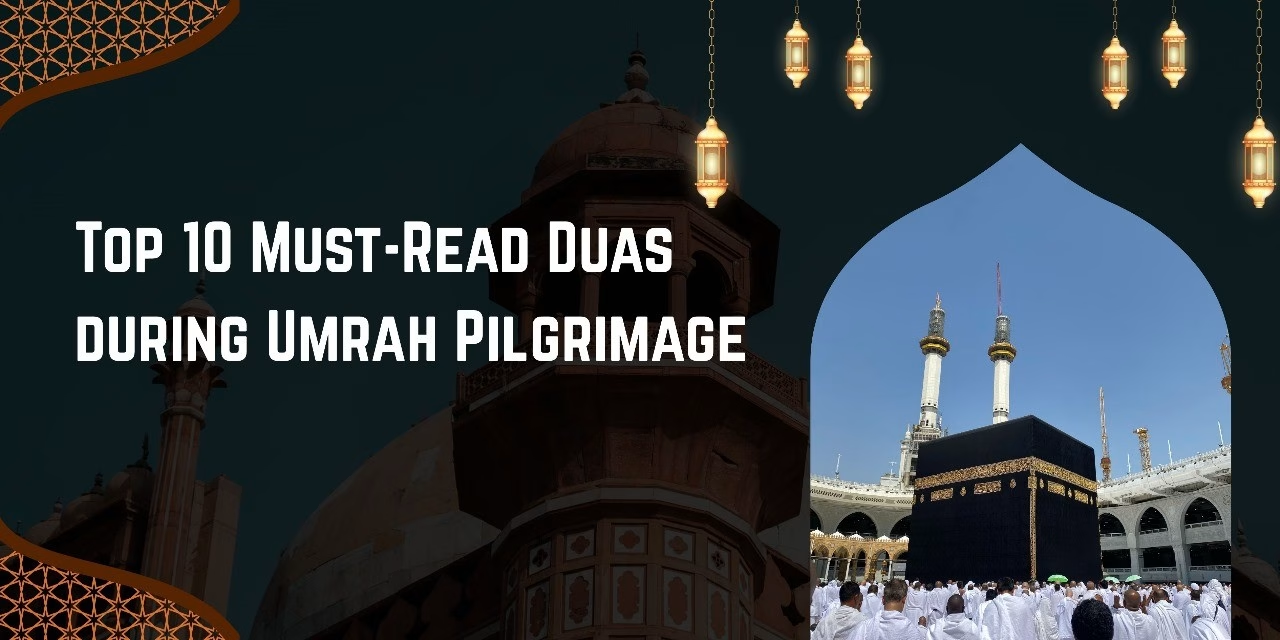
Essential Duas for Umrah: Guide to Spiritual Supplications
Top 10 Must Read Duas during Umrah Pilgrimage
In Islamic terms, Dua is presenting your needs to Allah SWT and asking for help from Him. It’s an essential part of worship and a means to connect a person to Allah SWT. With the power of Duas, a person’s difficulties can be removed, and the heart gets peace. Prophet Muhammad ﷺ said:
“The supplication is the worship.” – Refrence : Jami’ at-Tirmizi 2969
Dua is an Arabic word meaning “to call upon or to invoke”. There are many types of Duas that a Muslim recites on different occasions. Additionally, the specific Duas during the Umrah pilgrimage are also recited on various steps and rituals. Even a devout Muslim spends his entire day making Duas during the Umrah journey.
During Umrah, you should seek forgiveness and blessings from Allah SWT in front of Baitullah (the Holy Kaaba). These top 10 must-read Duas during Umrah that one must recite when visiting Makkah.
-
Dua at the Time of Intention (Niyyah) for Umrah
The intention in one’s heart is to do an action for the sake of Allah SWT. Did you know? In Islam, the responsibility of every action depends on the intention of a Muslim. As we make intention before starting Namaz, we do the same but in different words, Duas during Umrah. Remember, intention comes from the heart, so it’s not mandatory to say words.
For starting Umrah, intend in your heart and mind that you are performing Umrah for only Allah SWT.
۞ اللَّهُمَّ إِنِّي أُرِيدُ العُمْرَةَ فَيَسِّرْهَا لِي وَتَقَبَّلْهَا مِنِّي
“O Allah! I intend to perform Umrah, so make it easy for me and accept it from me.”
-
The Talbiyah: Supplication After Wearing Ihram
Talbiyah is a special Dhikr that a Muslim recites repeatedly after making the intention of Ihram or Umrah. In this, “Labbaik (I’m present)” is said on Allah SWT calls for your Umrah. Here is the specific Dua for this:
۞ لَبَّيْكَ اللَّهُمَّ لَبَّيْكَ، لَبَّيْكَ لَا شَرِيكَ لَكَ لَبَّيْكَ، إِنَّ الحَمْدَ وَالنِّعْمَةَ لَكَ وَالمُلْكَ، لَا شَرِيكَ لَكَ
“Here I am, O Allah, here I am. Here I am, You have no partner, here I am. Surely, all praise, blessings, and sovereignty belong to You. You have no partner.”
This Dua/Talbiyah is recited again and again until you reach Makkah. As one approaches the first circle of the Tawaf around the Kaaba, stop the recitation of this Talbiyah Dua. It can be recited as many times as one considers worthwhile. It has been designated that reciting the Talbiyah is “Sunnah Mu’akkadah” or “strong Sunnah” as Duas during Umrah.
-
Dua When Seeing the Holy Kaaba
When you see the Kaaba for the first time, you can recite Dua at that time. However, there is no specific authentic Dua proven from Prophet Muhammad ﷺ that you must recite. But in some traditions, it’s mentioned that when you see the Kaaba, the Duas during Umrah you make are accepted by Allah SWT.
That’s why scholars have said that at that time one should pray according to the desires and needs of one’s heart. Muslims usually recite this Dua:
۞اللَّهُمَّ زِدْ هَذَا الْبَيْتَ تَشْرِيفًا وَتَعْظِيمًا وَمَهَابَةً وَبِرًّا
“O Allah, increase this House (the Kaaba) in honor, greatness, reverence, and virtue.”
-
Common Dua During Tawaf
According to Hadiths, there is no fixed Dua that you can recite during Tawaf. In each round of Tawaf, an Umrah pilgrim recites the name of Allah SWT, performs Dhikr & Tasbih, and offers Duas for their needs. It is proven from Sahaba and Salaf that they used to recite Tasbeeh, Tahmeed, Takbeer, and Tahlil during Tawaf. That is why this is recommended to recite:
۞سُبْحَانَ اللَّهِ، وَالْحَمْدُ لِلَّهِ، وَلَا إِلَهَ إِلَّا اللَّهُ، وَاللَّهُ أَكْبَرُ
“Glory be to Allah, and all praise is for Allah, and there is no deity except Allah, and Allah is the Greatest.”
-
Dua Between Rukn al-Yemeni and Hajar al-Aswad
Prophet Muhammad ﷺ recited a special Dua between this part of the Holy Kaaba, Rukn al-Yemeni (southern corner) and Hajar al-Aswad (eastern corner). Here, it’s Sunnah to recite this Dua:
۞رَبَّنَا آتِنَا فِي الدُّنْيَا حَسَنَةً وَفِي الآخِرَةِ حَسَنَةً وَقِنَا عَذَابَ النَّارِ
“Our Lord, give us good in this world, and good in the Hereafter, and protect us from the punishment of the Hellfire.”
You can also find this Dua in the Holy Quran’s chapter two, which is Surah Al-Baqarah (verse 201). Islamic sources hold that Prophet Muhammad ﷺ specifies this Dua, and He ﷺ often used to recite it between the above-mentioned corners of the Holy Kaaba.
-
After Two Rak’ah Salah at Maqam-e-Ibrahim
Maqam-e-Ibrahim is a place (stone structure) very close to the Kaaba, where Prophet Ibrahim (A.S) left His footprints while building the Kaaba structure. Pilgrims of Umrah offer two Nafl Rak’ah prayers in this place after performing Tawaf.
This is again a Sunnah act of Tawaf, and you offer this to worship & thank Allah SWT. This is what the Holy Quran is saying about Maqam-e-Ibrahim:
۞وَاتَّخِذُوا مِن مَّقَامِ إِبْرَاهِيمَ مُصَلًّى
“And take the standing place of Abraham as a place of prayer.” – Surah Al-Baqarah: 125
Pilgrims can recite any Dua here, and common ones are asking Allah SWT for forgiveness and praying for sustenance, blessings, for family, and the Muslim Ummah around the world.
For those exciting pilgrims, cheap Umrah packages 2025 offer an opportunity to visit Maqam-e-Ibrahim and other holy sites. These packages will make your pilgrimage affordable and spiritually fulfilling.
-
Supplication Before Performing Sa’ee
Safa and Marwah are the hills where Umrah pilgrims perform the Sa’ee ritual. Safa is the first hill to be climbed, and then towards Marwah. Continuously, pilgrims do seven laps between both. Here, performing Sa’ee is an integral part of both Hajj and Umrah. Before starting the Sa’ee on the first hill, it’s Sunnah to recite the following Dua only once:
۞إِنَّ الصَّفَا وَالمَرْوَةَ مِن شَعَائِرِاللَّهِ
“Indeed, as-Safa and al-Marwah are among the symbols of Allah.” – Surah Al-Baqarah: 158
-
Dua Upon Reaching the Safa Hill
Before starting the Sa’ee, pilgrims should recite the following Dua. This strong Dua can be recited once you reach the first hill:
۞لَا إِلَهَ إِلَّا اللَّهُ وَحْدَهُ لَا شَرِيكَ لَهُ، لَهُ المُلْكُ وَلَهُ الحَمْدُ، وَهُوَعَلَى كُلِّ شَيْءٍ قَدِيرٌ
“There is no God but Allah, He is One and has no partner. All sovereignty belongs to Him, all praise is for Him, and He is capable of all things.”
-
Make Dua Again at Safa
You can recite this Dua by raising your hands in Safa while facing the Kaaba. It’s also Sunnah to recite.
۞اللّٰهُ أَكْبَرُ اللّٰهُ أَكْبَرُ اللّٰهُ أَكْبَرُ وَلِلّٰهِ الْحَمْدُ
“Allah is the Greatest, Allah is the Greatest, Allah is the Greatest. And all praise is for Allah.”
However, there is no fixed Duas during Umrah for pilgrims to recite while performing Sa’ee, which involves walking seven laps. At this time, any personal and spiritual supplication can be made. At each end, pilgrims pause and recite their own prayers softly or quietly.
Note: According to Prophet Muhammad’s ﷺ teachings, for Duas 8 and 9, repeat each three times while inserting your personal prayers between each repetition.
-
Dua for Leaving the Masjid Al-Haram
Once you have performed all of the major rituals and Duas during Umrah in Masjid Al-Haram, you are free to leave and complete the final step Qasr (Halq/Taqsir). Before leaving the Grand Mosque of Makkah, recite this Dua:
۞بِسْمِ اللّهِ وَالصَّلاَةُ وَالسَّلاَمُ عَلَى رَسُولِ اللّهِ، اَللَّهُـمَّ إِنِّي أَسْأَلُكَ مِنْ فَضْـلِكَ
“In the Name of Allah, and blessings and peace be upon the Messenger of Allah. O Allah, I ask from your bounty.”
You can also say this in your heart or by mouth, اللَّهُمَّ تَقَبَّلْ مِنِّي [O Allah! Accept this (Umrah) from me] This is only a general Dua, not proven from any Hadith, but mentioned in the Holy Quran’s Surah Al-Baqarah.
